

Artificial intelligence has moved well past answering simple questions and generating text. In 2026, a more powerful form of AI is taking center stage one that does not wait to be told what to do. It plans, makes decisions, and takes action. Welcome to the era of agentic AI.
Whether you are a business owner, a developer, or someone just trying to keep up with fast-moving technology, this guide covers everything you need to know what agentic AI is, how it works, real-world use cases, and why it may be the most important technology of this decade.
What is Agentic AI?
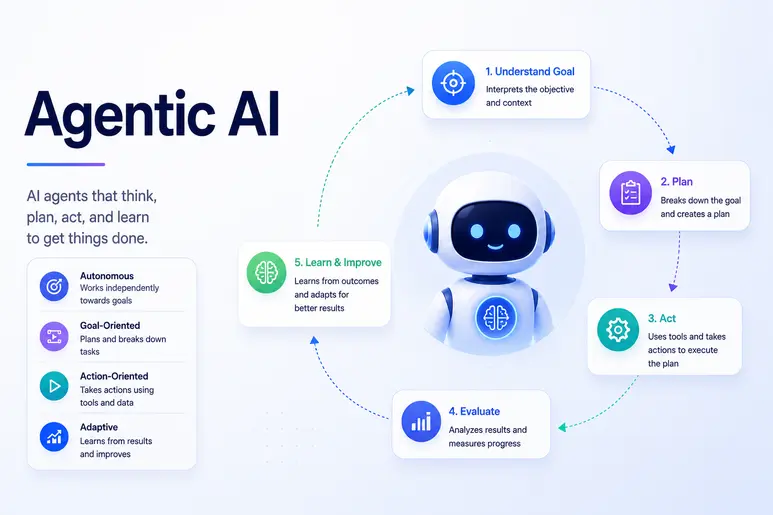
Agentic AI refers to autonomous artificial intelligence systems that can plan, decide, and execute multi-step tasks with minimal human involvement. Unlike standard generative AI that produces outputs only when prompted, agentic systems operate independently through a continuous loop of perceiving their environment, reasoning through a problem, planning the steps, and taking action.
In plain terms: traditional AI waits for you. Agentic AI gets to work on its own.
Think of it like giving a highly capable employee a goal. Instead of needing instructions at every step, they figure out the approach, use the right tools, and deliver results independently.
Agentic AI vs. Traditional AI: Key Differences
Most AI tools, chatbots, image generators, and recommendation systems are reactive. They respond when prompted, but do not plan or follow through on complex, multi-step goals.
Agentic AI extends beyond this by applying large language models (LLMs) toward specific, goal-directed objectives. The defining characteristic is autonomous purpose: agentic systems analyze what needs to happen, plan the steps, execute multi-stage workflows, adapt when circumstances change, and coordinate with other tools or agents to complete complex tasks.
This is why 79% of organizations have now adopted AI agents to some extent, according to a 2025 PwC survey of over 1,000 business leaders and the number is climbing sharply.
How Does Agentic AI Work?
Agentic AI operates through four core stages that repeat in a continuous loop:
• Perception: The system ingests inputs such as text, data, images, or API signals and processes them into a representation it can reason over.
• Reasoning: It interprets the situation, infers context, weighs constraints, and evaluates what needs to happen next.
• Planning: It breaks down a high-level goal into smaller sub-tasks, selects tools, and models expected outcomes.
• Action: It executes each step using APIs, databases, software platforms, or other connected systems and monitors for deviations.
What makes this loop powerful is that it does not stop after one action. The agent evaluates the result, adjusts its approach if needed, and keeps progressing toward the goal. It can also pull real-time information, trigger actions in external systems, and hand work off to other specialized agents.
Real-World Examples of Agentic AI in 2026
Agentic AI is not a future concept; it is already transforming how industries operate across the board.
Sales & Marketing
An agentic AI system identifies high-intent leads from CRM data, launches personalized outreach emails, replies to follow-ups, and books demos, all without human involvement. Early deployments are reporting 4 to 7 times higher lead conversion rates compared to traditional outreach methods.
Healthcare
The healthcare sector already has 68% AI agent usage among organizations. Agents assist in diagnosis, treatment planning, and drug discovery by processing medical records and research literature in real time. AI applications in healthcare are projected to generate up to $150 billion in annual savings by 2026, according to Accenture.
Finance & Banking
Banks using agentic AI for workflows that have reported productivity gains of 200% to 2,000%, according to McKinsey. Agents autonomously handle credit assessments, loan calculations, compliance checks, and fraud detection tasks that once required entire teams.
Supply Chain & Logistics
By analyzing sales data, inventory levels, and shipping feeds simultaneously, agentic AI predicts demand, optimizes routing, and automates reordering, keeping operations resilient even during disruptions. Companies applying AI to predictive maintenance have seen a 67% reduction in unplanned downtime and a 92% accuracy rate in predicting failures up to 30 days in advance.
Why Agentic AI Matters in 2026
The numbers tell a clear story. According to Gartner, fewer than 5% of enterprise applications have embedded agentic capabilities in 2025. By the end of 2026, that figure is expected to reach 40% one of the steepest adoption curves in enterprise software history.
The market itself reflects this urgency. The agentic AI sector is growing at a compound annual rate of 43.84%, projected to expand from $5.25 billion in 2024 to over $199 billion by 2034. Organizations that delay adoption risk exponentially widening the competitive gap as rivals automate more, operate faster, and deliver better customer experiences.
Beyond market share, the productivity case is compelling. McKinsey reports that organizations using agentic AI have seen up to 30% reductions in operational costs and up to 50% faster processing times. And 62% of enterprises now project returns above 100% from their agentic AI investments.
Should You Be Concerned? The Human-in-the-Loop Approach
With greater autonomy comes the need for greater oversight. The most successful organizations in 2026 are not deploying agents blindly; they are designing clear boundaries, defining what agents can and cannot do, and keeping humans in charge of high-stakes decisions.
A common and effective model is human-in-the-loop deployment. In financial underwriting, for instance, an agent gathers data and drafts recommendations, while a human reviews and approves before action is taken. This balances the speed and scale of AI with the judgment and accountability of human oversight.
Governance matters here. Only 21% of organizations currently have mature autonomous agent governance in place which is why the smartest deployments in 2026 pair aggressive automation with equally rigorous controls.
Final Thoughts
Agentic AI represents one of the most significant shifts in how work gets done not just in tech, but across every sector. It is software that thinks ahead, takes initiative, and drives outcomes without needing constant direction.
Whether you are a business leader deciding where to invest, a developer building the next generation of applications, or someone simply trying to understand where AI is headed, agentic AI is the technology to understand right now.
The question is no longer whether it will reshape your industry. It is how soon.
